The Dreamer and The Dream:
A Tribute to Region 8 Activist Hall of Fame Member
Dr, Martin Luther King, Jr.
By Region 8 Webmaster John Davis
When we say the word activist, no name comes to mind faster than that of Dr. Martin Luther King, JR.
Martin Luther King, Jr. was born January 15, 1929 in Atlanta, Georgia. His grandfather was the Rev. A.D. Williams, pastor of the Ebernezer Baptist Church in Atlanta and the founder of the Atlanta Chapter of the NAACP. Dr. King’s father Martin Luther King, Sr. succeeded his father-in-law as the pastor at the Ebernezer Baptist Church following his death in 1931. The church was a major factor in the King household, with most activities revolving around the work of the church and community.
Dr. King attended Morehouse College in Atlanta, then went on to study at Crozer Theological Seminary in Pennsylvania and earned his doctorate from Boston University. In 1953 Dr. King married Coretta  Scott and accepted the pastorate at Dexter Avenue Baptist Church in Montgomery, Alabama in 1954. Settling down in Montgomery in 1955, the King’s were just getting started with their lives together and in a new work at Dexter Avenue. In December of 1955 Rosa Parks, an African American seamstress, refused to give up her seat on a bus in Montgomery. At the time the bus system of Montgomery called for blacks to sit on the back of the bus forward, while whites sat from the front to the back. The bus in which Mrs. Parks was riding became full and she took a seat toward the front of the bus. On the next stop a white man entered the bus and there were no seats left. The driver informed Mrs. Parks that she would have to give up her seat but she refused and was arrested. Scott and accepted the pastorate at Dexter Avenue Baptist Church in Montgomery, Alabama in 1954. Settling down in Montgomery in 1955, the King’s were just getting started with their lives together and in a new work at Dexter Avenue. In December of 1955 Rosa Parks, an African American seamstress, refused to give up her seat on a bus in Montgomery. At the time the bus system of Montgomery called for blacks to sit on the back of the bus forward, while whites sat from the front to the back. The bus in which Mrs. Parks was riding became full and she took a seat toward the front of the bus. On the next stop a white man entered the bus and there were no seats left. The driver informed Mrs. Parks that she would have to give up her seat but she refused and was arrested.
Her protest set off the Montgomery Bus Boycott as 42,000 black citizens in Montgomery refused to ride the bus system. Out of the boycott the Montgomery Improvement Association (MIA) was founded by black ministers and community leaders in the city. Dr. King became one of the leaders in the MIA as the non-violent protest of the bus system gained national attention. The boycott ended in November of 1956 when the Supreme Court struck down laws requiring segregated seated in public buses. Dr. King emerged as a national figure in the struggle and the stage was set for his work to further the cause of  civil rights for all people. civil rights for all people.
Following the victory in Montgomery, Dr. King was convinced the climate was right for social change in the United States. From the early days of the bus boycott he referred to Mahatma Gandhi as the “guiding light of our technique of non-violent social change.” Dr. King understood that winning the legal battle would be much easier than winning acceptance. He pointed to the people of India’s battle for independence from England as an example of non-violent change. Gandhi’s concept of peaceful resistance had allowed the people of India to gain their independence without the resentment that so many other oppressed people had suffered through the ages. In 1959 King and his wife Coretta traveled to India to study the teachings of Gandhi and his platform for non-violent resistance. As a matter of fact, Dr. King stated to the press “to other countries I may go as a tourist, but to India I come as a pilgrim.”
The trip made a profound impression upon Dr. King and he returned to America more determined than ever that non-violent protest could lead to the changes this country needed. Shortly after returning to Montgomery, he resigned his position at Dexter Avenue and joined his father as co-pastor of the Ebernezer Baptist Church in Atlanta.
The roll of the decade found America in the middle of growing discontent with the treatment of minorities, as more and more demonstrations and protest challenged the laws of segregation and discrimination. Dr. King continued his message of non-violent resistance and began to work with  student groups to help organize peaceful protest designed to bring to light the plight of minorities and the denial of their basic civil rights. However, Dr. King’s teaches clashed with some of the more militant leaders in the struggle. This resulted in many conflicts between the groups working for civil rights and hindered the cause. student groups to help organize peaceful protest designed to bring to light the plight of minorities and the denial of their basic civil rights. However, Dr. King’s teaches clashed with some of the more militant leaders in the struggle. This resulted in many conflicts between the groups working for civil rights and hindered the cause.
In the spring of 1963 Dr. King led a mass demonstration in Birmingham, where police officials were known for their violent opposition to integration. The unarmed protesters were greeted with fire hoses and police dogs. The clash made national headlines and President John Kennedy submitted to Congress broad civil rights legislation that would lead to the passage of the Civil Rights Act of 1964. Later in 1963 Dr. King took his message to Washington, D.C. with the March on Washington for Jobs and Freedom. Plans for the demonstration began the year before as the leaders of the civil rights movement felt that Washington was where the message had to be delivered. The event was planned for August 28, 1963.
The March on Washington was denounced by Malcolm X and the Nation of Islam, with the militant leader referring to it as the “farce on Washington.” His opposition to the demonstration was so great that it was decided that any member of the Nation of Islam that attended the march would be subject to a 90 days suspension from the organization. The conflict grew so great, that the National Council of the AFL-CIO chose to remain neutral and not participate in the event. However, hundreds of other unions participated in the march with UAW President Walter Reuther joining Dr. King on stage and over 250,000 other protestors including singers Joan Baez, Peter, Paul and Mary and Bob Dylan voiced their opposition to segregation.
At the culmination of the event Dr. King delivered his “I Have a Dream” speech. This vision for a better world has become one of the greatest oracles ever delivered. Following the march Dr. King met with President Kennedy at the White House, with the President committing to throw the full weight of his office behind the Civil Rights Act. Later King’s chief aide Ralph Abernathy would write “The March on Washington established visibility in this nation. It made it clear that we did not have to use violence to achieve the goals which we were seeking.”
President Kennedy’s commitment to Dr. King ended a couple months later when he was assassinated on November 22, 1963. Eight months later the Civil Rights Bill was passed into law July 02, 1964. The legislation was passed just two days short of Independence Day.
Dr. King won the Noble Peace Prize in 1964 after being named Time Magazine’s Man of the Year in 1963. In 1967 he initiated his “Poor People’s Campaign” and attended a rally to support striking sanitation workers in Memphis, Tennessee. On April 03, 1968 he delivered his final address “I Have Been to the Mountain Top” to those assembled for the rally. His voice for freedom, equality and the rights of all people was silenced the next day by an assassin’s bullet. He joined his friend John F. Kennedy as another who died in the struggle to build a better world.
UAW President Walter Reuther was a strong supporter of Dr. King and the Civil Rights movement. They met in 1959 and developed a friendship that grew out of the common commitment for the betterment of all people. Walter Reuther joined Dr. King on many marches and demonstrations. He was along for the Birmingham march in 1963 as fire hoses and guard dogs were turned on the marchers. It was Walter Reuther who bailed Dr. King out of jail following his arrest.
Walter Reuther not only attended the March on Washington, but he was the only white speaker that day. In the months that lead up to the march, Dr. King was given an office at the UAW’s headquarters in 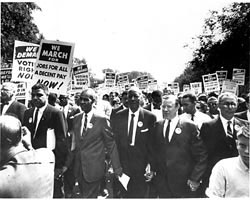 Detroit to plan the march. The “Walk to Freedom March” that took place in Detroit was lead up to the March on Washington. This march was also planned from King’s office at Solidarity House in Detroit. That march took place down Woodward Avenue and ended at Cobo Hall where King delivered his “I Have a Dream” speech for the first time. Detroit to plan the march. The “Walk to Freedom March” that took place in Detroit was lead up to the March on Washington. This march was also planned from King’s office at Solidarity House in Detroit. That march took place down Woodward Avenue and ended at Cobo Hall where King delivered his “I Have a Dream” speech for the first time.
When Walther Reuther learned of Dr. King’s death on April 04, 1968, he jumped on a plane for Memphis and carried a $50,000 donation to the striking sanitation workers before heading to Atlanta to attend Dr. King’s funeral. Next May Walther Reuther lost his life in plane crash. Another voice for justice had been silenced.
Dr. King could have taken his education and lived a comfortable life in the suburbs, raising his family and knowing the rewards of his education. His family could have lived better than the average African-American household at the time, somewhat buffered from the discrimination that plagued his brothers and sisters of race. However, he chose instead to step out and leave the comfort zone of his stature and fight the good fight for others. His was a path of heart rather than a path of convenience.
On the annual observance of the Dr. King Holiday, may we all remember the man and his message of non-violent resistance. The race of life is not measured on where you finish, but rather how you run; Dr. Martin Luther King. Jr. ran his race with determination and courage. Today it is up to each of us to take up the race where this great man left off. How will you run?
|


