UAW President Walter Reuther 1907-1970
Bio Compiled By Region 8 Webmaster John Davis
Walter Reuther served as President of the UAW from 1946 until his death in 1970. Walter Reuther was committed to working people and fought tirelessly throughout his lifetime to improve the rights and compensation of working class Americans both at the bargaining table and in the halls of Congress.
Walter Reuther was born in Wheeling, West Virginia on September 01, 1907, the second of five children. His father was a union driver for a brewery and had immigrated to America from Germany. His father instilled in his boys the importance of unions and their responsibility to be at the forefront of social and economic justice.
Reuther dropped out of high school and completed an apprenticeship in tool and die work. After being 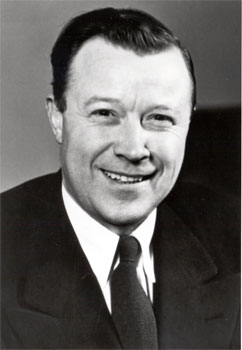 fired for trying to organize a union at his shop in West Virginia, he moved to Detroit and was hired at Ford’s River Rouge plant. Earning a reputation as an excellent mechanic, Walter Reuther completed his high school diploma in 1922 and began taking classes at Detroit City College (now Wayne State). He was soon joined in Detroit by his brothers Roy and Victor who also enrolled in Detroit City College. fired for trying to organize a union at his shop in West Virginia, he moved to Detroit and was hired at Ford’s River Rouge plant. Earning a reputation as an excellent mechanic, Walter Reuther completed his high school diploma in 1922 and began taking classes at Detroit City College (now Wayne State). He was soon joined in Detroit by his brothers Roy and Victor who also enrolled in Detroit City College.
The Great Depression consolidated the political and social activism of the Brothers Reuther and they formed a Social Problems Club on the campus. The group protested many of the unjust policies being practiced around the city including the segregationist policies of the local swimming pool.
The next year Walter and Victor left Detroit to tour the world, ending up working at a Ford facility in Russia. He returned to Detroit in 1935 and fell in love with a pretty physical education teacher named May Wolf. They were married in 1936.
That same year Walter Reuther began his rise through the ranks of the union. He first joined Local 86, which represented workers at GM’s Temstadt parts plant even though he didn’t work there. He went on to be elected as a delegate to the 1936 UAW national convention where his speaking skills led to his election to the International Executive Board.
Next Reuther was elected President of UAW Local 174, an amalgamated local representing 76 shops and 30,000 workers. He helped play a key role in planning the successful sit-down strikes that brought the UAW to GM in Flint, Michigan. These strikes were successful in winning union recognition at both GM and Chrysler but Ford had resisted organization. On May 26, 1937 Walter Reuther and several other union activists were handling out material on the overpass from the parking lot at Ford’s River Rouge plant when they were severely beaten by Ford thugs. Newspapers caught the event and the brutality shown by Ford made the headlines nation wide. The event became known as “the battle of the overpass” and brought national attention to the struggles that workers were facing to win the right for union representation.
In 1939 Reuther became the director of the UAW’s GM Department and was elected the union’s first 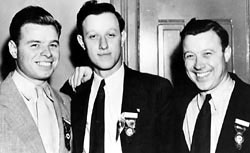 vice-president in 1942. In 1940 Reuther suggested converting excess capacity in the auto industry to military production. President Roosevelt had called on the nation to take an “Arsenal of Democracy” stance to prepare for war and Walter Reuther was in complete agreement. Corporations argued against the idea, not wanting to give up any portion of their business. After the attack on Pearl Harbor in 1941, Reuther’s vision of the auto industry turning out 500 planes a day became a reality. President Roosevelt became friends with the UAW leader and asked him to participate on a number of wartime boards. The friendship between both Franklin and Eleanor Roosevelt and Walter and May Reuther would last the remainder of their lives. vice-president in 1942. In 1940 Reuther suggested converting excess capacity in the auto industry to military production. President Roosevelt had called on the nation to take an “Arsenal of Democracy” stance to prepare for war and Walter Reuther was in complete agreement. Corporations argued against the idea, not wanting to give up any portion of their business. After the attack on Pearl Harbor in 1941, Reuther’s vision of the auto industry turning out 500 planes a day became a reality. President Roosevelt became friends with the UAW leader and asked him to participate on a number of wartime boards. The friendship between both Franklin and Eleanor Roosevelt and Walter and May Reuther would last the remainder of their lives.
In 1946 Walter Reuther asked GM for a 30% raise and the ensuing struggle resulted in a 116-day strike. Reuther challenged GM to open the books to prove it wasn’t possible to grant the 30% raise. GM refused but offered an 18% raise, which was accepted by the UAW.
He was elected to the Presidency of the UAW in 1946, bringing along a post war agenda that included national health care, economic redistribution and job security. While he wasnt able to accomplish these things for all working Americans, Reuther was successful in reaching those goals for his members. In 1948 GM agreed to add the cost of living allowance and future gains included health care, the grievance procedure, health and safety provisions, pensions and supplemental unemployment benefits. Walter Reuther’s bargaining table gains for UAW members set the standard for workplace compensation as 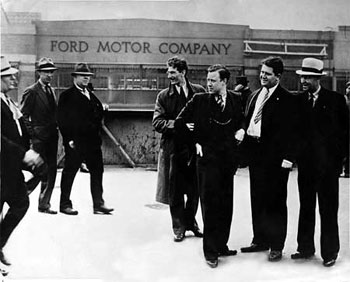 hundreds of thousands of non-union members enjoyed benefits made the standard by the UAW. hundreds of thousands of non-union members enjoyed benefits made the standard by the UAW.
His efforts for workers made Walter Reuther public enemy number one by the corporate hoodlums that ran the industry. In 1938 he was almost kidnapped and murdered by gunmen. In 1948 another assassination attempt failed to end his life, but left permanent damage to his right arm. Dubbed “the most dangerous man in Detroit,” Walther Reuther didn’t let these attempts on his life weaken his resolve, but rather used it as inspiration to push harder for the rights of America’s workers.
Walther Reuther held a strong belief that the breadbox and ballot box were connected. He was often quoted as saying “it doesn’t matter what you win at the bargaining table, if the gains can be legislated away in the halls of Congress.” Beginning with Franklin Roosevelt, President Reuther became an advisor to each of the Democratic Presidents all the way to Lyndon Johnson. His convictions pushed his belief that the Federal Government should guarantee the civil liberties of its citizens as he pushed to expand social programs for the less fortunate. Reuther used his political clout to help millions of citizens, regardless of their affiliation with the UAW. He was a strong advocate of tying Social Security to workers pensions to reduce the amount of expense to companies from their pensions plans. His efforts resulted in the first raise in Social Security in 12 years, which benefited every recipient – not just his members.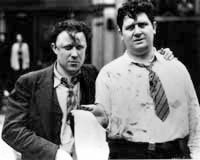
The rights of all people was another battle that found Walter Reuther on the frontlines. In 1959 he met Dr. Martin Luther King, Jr. and the two became fast friends. While some labor organizations were slow to come on board with the Civil Rights movement, President Walter Reuther committed the UAW’s help up front. Reuther joined Dr. King on many of his marches and gave an address to the crowd to open the historic “march to Selma.” Again he joined Dr. King to protest in Birmingham as the crowd was met with fire hoses and police dogs. It was in fact Reuther who bailed King out of jail following the demonstration.
In 1963 Dr. King felt the time was right to take their message to the national stage and began planning a march on Washington. However, being the methodical thinker that he was, King decided to hold a march in Detroit to test the waters before going to Washington. The “Walk to Freedom March” was organized from an office at the UAW’s headquarters Solidarity House, with space donated by Walter Reuther. Dr. King also planned the March of Washington from the same office.
During the March on Washington, Walter Reuther was the only Caucasian to speak from the podium that day. Afterwards, one of Reuther’s aides overheard two ladies backstage discussing who he was. One asked the other is she knew him, to which came the reply “that is Walter Reuther, and he is as good a 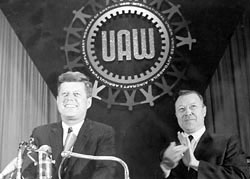 man as Dr. King.” It is said that Reuther always considered that statement a great compliment. man as Dr. King.” It is said that Reuther always considered that statement a great compliment.
President Reuther knew that education was the key to social improvement and late in his life he dedicated much of his time to that cause. His final achievement was building the Walter and May Reuther Family Education Center (better known as Black Lake) in northern Michigan. The vision included classrooms and facilities so UAW members could assemble and be educated on the issues of the day. Reuther took an extreme interest in the project, even personally deciding which trees would be saved in the construction. The center rivals anything of its kind in terms of design and purpose. On May 09, 1970 Walter and May Reuther, Architect Oscar Stonorov and their pilot were on their way to view the completed facility just prior to the official opening. Their plane went down in a rainstorm near Pellston, Michigan. 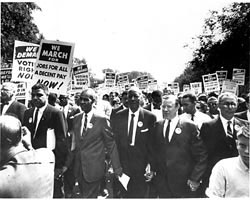
Walter Reuther is quoted as saying “There is no greater calling than to serve your fellow man. There is no greater contribution than to help the weak. There is no greater satisfaction than to have done it well.” If this is the case, then Walter Reuther must have surely died a satisfied man. His contributions to working class people the world over should never be forgotten. Reuther knew that social justice is at the heart of everything that organized labor stands for and his legacy is an inspiration to all those who continue his work today.
|


