UAW Celebrates Dr. King Holiday
by John Davis
On January 20, 2003, America will observe
the Dr. Martin Luther King, Jr. holiday. The holiday was passed into law
on November 02, 1983 with the first observation taking place on January
20, 1986. Since that time, the third Monday in January has been set aside
to remember Dr. King.
The United Auto Workers have long recognized the contributions
that Dr. King made to working class Americans. UAW President Walter
Reuther took to the streets marching many times with Dr. King. UAW members
across the country joined in the fight for civil rights, with Dr. King
at the helm.
Martin Luther King, Jr. was born January
15, 1929 in Atlanta, Georgia. The son of a minister and civil rights
activist, King found himself following a similar path as he grew into
a man. He completed his doctorate in systematic theology in 1955 from
Boston University. Rejecting offers of academic positions, King moved
to Montgomery, Alabama as Pastor of the Dexter Avenue Baptist Church.
In December of that year, he participated in the bus boycott of Montgomery
after Rosa Parks refused to obey the city's mandatory bus segregation
law. He was elected as President of the newly formed Montgomery Improvement
Association. As the bus boycott continued into 1956, Dr. King gained
national prominence for his speaking skills and courage.
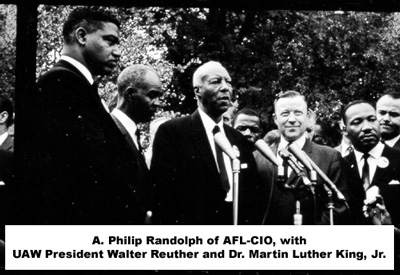
In 1963, the civil rights movement staged the "March
of Washington" ending with Dr. King's memorable "I Have a
Dream" speech. At his side was UAW President Walter Reuther. Two
years later, Walter and May Reuther joined Dr. King in Selma, Alabama
for another march. Walter Reuther delivered a speech with Dr. King,
standing atop a cane-bottomed chair. He told the crowd there, "The
struggle will be carried on until every American can share in the blessings
of human dignity. Let us take heart, our cause is just and human justice
will prevail."
Dr. King was a tireless promoter of equality, while
maintaining the idea of peaceful demonstration. He was awarded the Nobel
Peace Prize and named Time Magazine's Man of the Year in 1964. His peaceful
stance drew criticism from members of the Black Nationalists, particularly
from "Black Power" proponent Stokely Carmichael. Even in the
face of resistance and criticism, Dr. King continued his message of
non-violent demonstration. Just six blocks into his famous march from
Selma to Montgomery, state troopers attacked the group killing two ministers
- one black and one white. Seventeen others were hospitalized and over
70 were injured. This violence did not deter Dr. King, as his stance
of peaceful demonstration continued.
In 1965, President Lyndon Johnson signed the Civil Rights
Act into law. However, problems continued for the country. The 1960's
were a time of much unrest, and Dr. King became convinced that poverty
was the driving factor for this. Not only poverty of African-Americans,
but poverty of poor whites, Hispanics, and Asians. When his focus broadened
across the issues facing all racial groups, he once again found resistance
from members of his only coalition. They felt that Dr. King should keep
his focus on the issues facing African-Americans. He felt that all down-trodden
people should be helped and continued to push for the rights of all
working Americans. It was this cause that took him to Memphis, Tennessee.
On April 3, 1968, Dr. King marched with striking sanitation
workers in Memphis. In what would be his last speech, Dr. King urged
the strikers to press ahead. "I just want to do God's will and
he allowed me to go up to the mountain. I've looked over and I've seen
the promise land. I may not go there with you, but I want you to know
tonight that we as a people will get the promise land," King stated
to the crowd of striking workers from all races. The next day, he was
shot and killed leaving his hotel room.
In the last speech, Dr. King left a message for us all.
A message that we should seek out all those who are down-trodden and
lift down our hand to them and be willing to stand and be counted. Struggles
continue today. While much progress has been made, there is still much
to do. We in labor know this struggle and fight it everyday. We fight
it on the picket lines, we fight it at the bargaining table, we fight
it in the halls of Washington and we fight it on foreign soils where
people are persecuted and put to death for banding together. Dr. King
had a dream, and that dream lives today in each of us. For that dream
to be a reality, we each must be willing to step out and be counted
when the time comes to stand up for one another.
On January 20, local unions all around the country will
stop and remember Dr. King and the contributions he made to people of
all races. May we never forget the sacrifices that have been made to
insure the rights we enjoy today. |